
Every summer, the Plastic Free Foundation commemorates its global initiative that challenges the public to reduce plastic waste. Where fashion is concerned, that translates to eschewing petroleum-based textiles like polyester – which is actually a form of plastic – and employing natural fibers like cotton.
Such a move by the industry would be quite impactful, considering nearly 70 percent of apparel is made from fossil fuel-based textiles. These textiles shed tiny microfibers – or microplastics – through both washing and wearing. Microplastic particles have been found in our food supply, drinking water, air and bodily organs. And because it can take hundreds of years for plastics to decompose, the problem will persist, affecting both the environment and human health.
“Plastic leakage is defined as the plastic leaving the technosphere and accumulating in the natural environment,” explained Cotton Incorporated’s Jesse Daystar, Ph.D., vice president and chief sustainability officer in a CottonWorks webinar entitled, “Plastic Pollution and Textiles: What the Science Says and Why…” “In the context of apparel, a polyester T-shirt thrown on the ground (or thrown in a landfill) would be plastic leakage through the synthetic microfibers coming off our clothing.”
Daystar said in the course of the webinar that Cotton Incorporated’s research with Quantis and Earth Action shows 14% of all plastic leakage comes from the apparel industry. At 8.3 million metric tons every year, this microplastic waste equals roughly 820 times the weight of the Eiffel Tower or 23 times the weight of the Empire State Building.
Consumers Are Increasingly Aware of Microplastic Pollution
This should raise flags within the fashion industry, as consumers are increasingly aware of microplastic pollution and are beginning to connect it with their clothing.
According to Cotton Council International and Cotton Incorporated’s 2026 Global Sustainability Survey of 1,022 respondents, 41% of U.S. consumers are aware of plastic waste from synthetic fibers like polyester ending up in the oceans or on land—up from 17% in 2017.
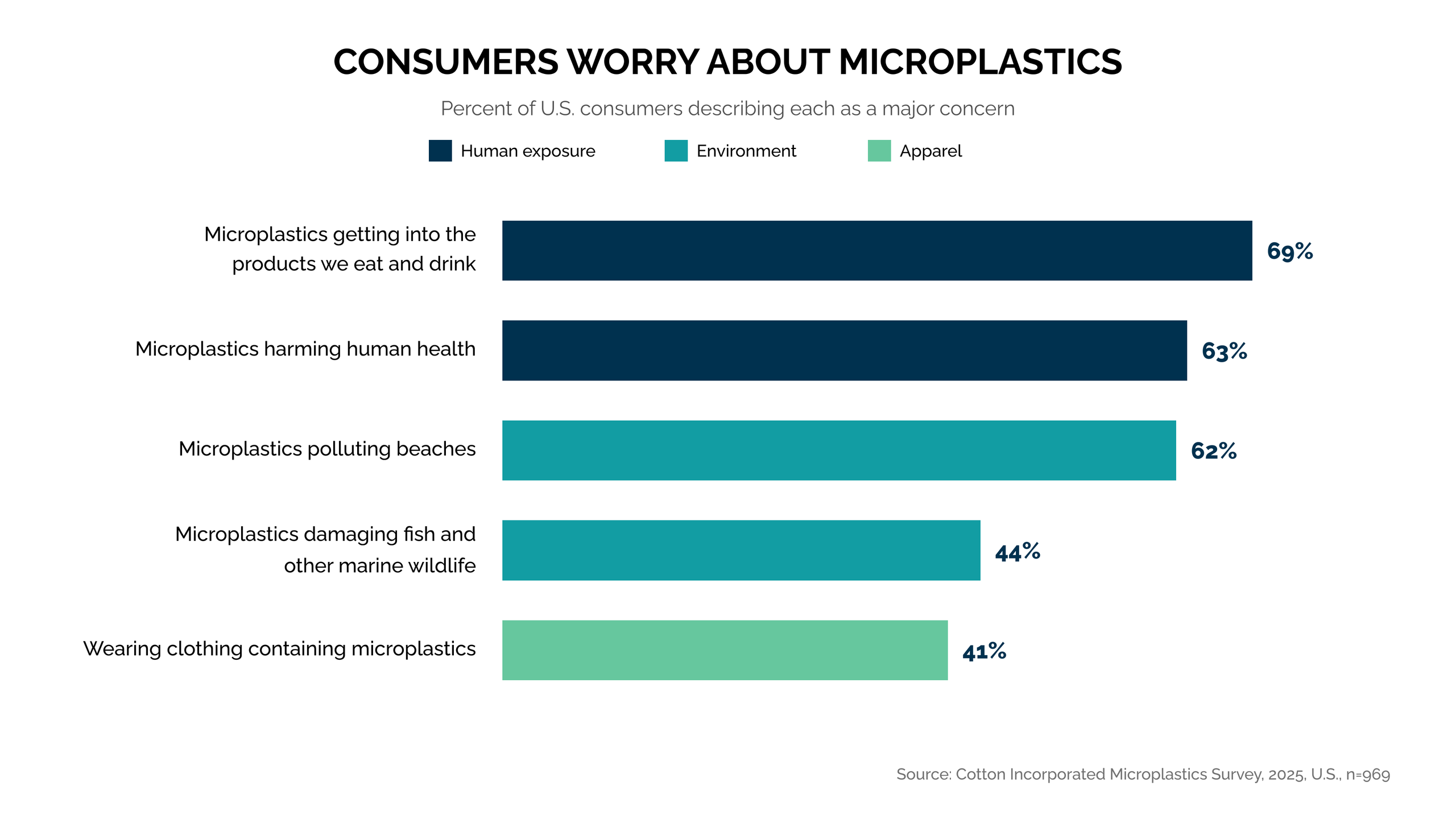
While more consumers say they have major concerns about these microplastics getting into products they eat or drink (69%), damaging fish and other marine life (44%), harming their health (63%), or polluting beaches (62%), 41% worry about simply wearing clothing containing microplastics, per Cotton Incorporated’s 2025 Microplastics Survey (n=969). Unsurprisingly, shoppers increasingly say they look for clothes made from natural fibers (76%, up from 71% in 2023) and biodegradable fibers (58%, up from 52% in 2023), according to the Global Sustainability Survey.
Natural Fibers in Fashion
Gabriela Hearst, the luxury designer who founded her own label and previously served as the creative director of Chloé, understands this consumer sentiment. In fact, her team says it is part and parcel of the brand’s mission.
“Every collection is made up of only natural fibers,” said Gabriela Hearst’s Austin Chevier, head of fabric, in an interview with the Lifestyle Monitor™. “This was an incredibly conscious choice. Since the beginning, Gabriela Hearst as a brand has utilized only natural, unaltered fibers, including cotton, linen, silk, wool and cashmere, not only for their sustainability but also for their incredible diversity and longevity. We are able to utilize natural fibers in place of many synthetics because of their inherent natural properties. I think people forget the diversity that natural fibers can achieve.”
California Cloth Foundry, a Los Angeles-based brand and retailer, has made it their objective to be “plastic-free in collaboration with nature.”
“Our purpose at California Cloth Foundry is to help heal the industry through natural, clean and healthy textiles and apparel without petrochemicals,” said Lydia Wendt, founder and principal, in an interview with the Lifestyle MonitorTM. “Cotton is one of the most luxurious of the plant-based fibers and fits with our mission naturally. It is easily converted from the plant into beautiful and diverse products, and blends well with our other natural fibers.”
Though the industry relies on fossil fuel-based textiles, Wendt explained why she and the brand are adamant about resisting.
“Plastic textiles, along with petrochemical dyes and coatings, are among the most toxic elements of the fashion supply chain. They contaminate our air, water, soil and, ultimately, our bodies,” Wendt stated.
What the Science Says
In the CottonWorks™ webinar, Dr. Richard Venditti, professor at North Carolina State University, explained that all apparel sheds fibers. But only petroleum-based textiles like polyester contribute to microplastic pollution. In lab studies, his team concluded that in water conditions, cotton biodegradation neared 85% within 35 days, with further degradation occurring subsequently. Polyester saw virtually zero biodegradation. Venditti added that new “biodegradable polyester,” when tested in average environmental conditions over the course of 50 days, also saw zero decomposition, while cotton experienced almost 100% biodegradation.
As it stands, consumers consider cotton a safe fiber for the environment (78%), trailed by recycled polyester (54%) and by polyester and nylon (both 42%), according to the 2026 Global Sustainability Survey of 1,022 U.S. consumers. More than 6 in 10 shoppers (61%) say the fashion industry could help the microplastic pollution situation by switching from synthetics to natural fibers.
A Focus on Every Step of the Process
For its cotton pieces, Gabriela Hearst aims to only utilize fully traceable and sustainably sourced cottons with an emphasis on reducing water consumption.
“We focus on every step of the process from the growing, spinning and weaving/dyeing of the fabric, as every step in the chain has an impact on sustainability,” Chevier said.
Wendt added that using 100% clean and natural fibers, dyes and finishes is challenging — but worth it.
“With sustained dedication and work, we are able to produce strong, soft, comfortable and beautiful regenerative textiles that are a positive, healthy addition to our lives,” Wendt said. “Cotton is an invaluable asset to our mission and goal to protect future generations from harmful chemicals in textiles, while advancing healthy fabrics and clean fashion.”
Cotton is one of the most luxurious of the plant-based fibers and fits with our mission naturally. It is easily converted from the plant into beautiful and diverse products, and blends well with our other natural fibers.
Founder and Principal, California Cloth Foundry