
Cotton’s Advantage in the Nonwovens Market: 2025–2026 Highlights
The Cotton Incorporated New Market Development Department’s 2025–2026 Outlook Report evaluates cotton’s role in the market and opportunities for brand growth based on current trends and consumer preferences.
In 2025, the global nonwoven tissue and hygiene market continued to expand steadily, with an estimated total value of $118.56 billion in 2025 and a projected compound annual growth rate (CAGR) of +1.6% from 2025 to 2029.1
Cotton’s reputation as a comfortable, soft, high-quality material2 continues to strengthen in this environment. Although its overall presence across categories remains modest (22.8% of SKUs, –0.3 percentage points year-over-year),1 the fiber’s alignment with consumer expectations as safe for the environment2 makes it a central candidate for next-generation innovation.
Make Cotton Work for You
Get started incorporating cotton into your nonwoven products — and leveraging it for your brand story. Contact Neil Demarse, Director of New Market Development at Cotton Incorporated at [email protected].
Why Cotton?
Cotton remains a strong choice for nonwoven products due to several of its natural properties:
1. Cotton is hypoallergenic.3
For millions of people with sensitive skin, choosing non-irritating fibers is critical for nonwoven products, many of which make direct contact with their skin.
2. Cotton offers opportunities for innovation.
For example, cotton flock, or pulverized cotton, has been used for decades as a filler and reinforcement fiber in various industrial markets. Now, it can be used as a more sustainable option in nonwoven coform substrates.4
3. Unbleached cotton is minimally processed.
It offers medical and skin wellness benefits5 to nonwoven products.
4. Cotton helps avoid microplastic pollution.
Cotton fibers compost and return to the earth,6 while microfibers from synthetics release microplastics that persist in the environment.7
5. Cotton has circular possibilities.
It’s grown from the earth and can be reused, recycled,8 and returned to nature,6 which can help support brands’ sustainability goals.
Top Takeaways
A snapshot of the 2025-2026 nonwoven tissue and hygiene market and cotton’s presence in the market:

$118.56B
The value of the nonwoven tissue and hygiene market1

+1.6%
in the market’s CAGR1

+5.6%
CAGR for adult incontinence products1

30%
of baby care SKUs reference cotton1
Macroeconomic Landscape
The manufacturing and consumer landscape entering 2026 reflects a shift from policy uncertainty toward a more stable cost environment. U.S. GDP growth moderated to 1.4% in Q4 2025,9 while manufacturing returned to expansion in early 2026 (ISM: 52.6).10 A February 2026 Supreme Court ruling reversing many tariffs has further reduced sourcing uncertainty and improved cost visibility.
At the material level, fiber pricing has remained stable. U.S. cotton prices are range-bound at ~62–65 ¢/lb, and polyester pricing has plateaued, indicating a balanced input-cost environment.1 In contrast, rising Chinese cotton prices (~110 ¢/lb) suggest emerging global supply shifts.1 Overall, a combination of stable costs, easing policy pressure, and steady demand supports continued investment in innovation — positioning cotton as a versatile, sustainable alternative to synthetic fibers.
Overall, a combination of stable costs, easing policy pressure, and steady demand supports continued investment in innovation — positioning cotton as a versatile, sustainable alternative to synthetic fibers.
Global Market Overview1
| Region | 2025 Share of Market Value | Key Trend |
|---|---|---|
| North America | 33% | Focus on skin-safe, plant-based wipes |
| Western Europe | 27% | Regulation-driven shift toward biodegradable substrates |
| Asia Pacific | 30% | Rapid growth in baby and incontinence products |
| Latin America & Others | 10% | Localized sourcing, eco-positioning gaining traction |
Total Market Value (2025): $118.56 billion | CAGR (2025–2029): +1.6%
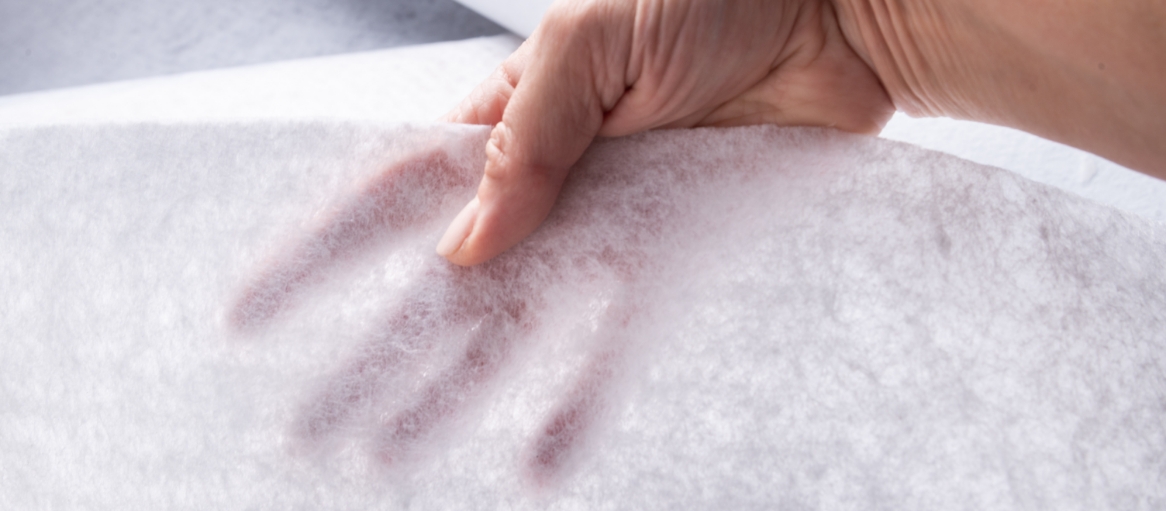
Cotton vs. Synthetics in Nonwovens
Four key properties give nonwoven tissue and hygiene products made from cotton an advantage over those made with synthetic fibers.
1. Hypoallergenic & Skin-Safe
Cotton is naturally hypoallergenic and gentle,3 unlike synthetic alternatives such as polypropylene or polyester. This helps make cotton ideal for baby wipes, facial wipes, and sensitive skin products.
2. Superior Absorbency & Wet Strength
Cotton’s structure allows for superior absorption and release capabilities, making it a viable delivery system for cleansers, moisturizers, and other formulations found in baby, personal care, and hygiene products. Additionally, cotton is naturally stronger when wet than dry,11 lending enhanced tear resistance to wet wipes.
3. Biodegradability & No Microplastic Pollution
A significant concern with synthetic textiles is their contribution to microplastic pollution. Research indicates that textiles are responsible for 35% of the primary microplastics found in our oceans.12 In contrast, natural fibers like cotton exhibit superior biodegradability.6
4. Regulatory Compliance
As regulations like the EU Single-Use Plastics Directive push for reduced plastic content in disposable products, cotton-based wipes offer a compostable6 alternative that fits seamlessly into this regulatory framework.13
Insights by Category
Baby Care
Cotton’s strongest presence is in Disposable Pants, with a digital SKU share of 23.5% in the USA and 29.2% in Canada. While leaders like Pampers and Huggies dominate volume, smaller brands are gaining ground by marketing “100% natural” and “non-GMO cotton.”1 Cotton aligns strongly with offering an advantage in disposable diapers and wipes.14,3
Wipes
Moist toilet wipes remain one of the fastest-growing categories, posting a +3.5% CAGR (2025–2030).1 Demand is driven by perceived improvements in hygiene and skin comfort compared to dry toilet tissue. Legislation on flushability labeling continues to intensify, particularly in states such as Hawaii, New Jersey, and California. Cotton’s presence in wipes remains limited but is increasingly featured in premium subcategories, supported by claims of softness and reduced irritation.
Sanitary Protection
The sanitary protection category is diverging across segments. Tampons are showing flat-to-declining growth, while pads and pantyliners continue to expand.1 Consumer demand is also shifting toward natural, plant-based materials such as organic cotton, bamboo, and hemp, driven by preferences for skin-friendly and sustainable products.1
While P&G maintains category leadership (~54% share), emerging brands like Cora are gaining traction by combining performance with purpose-driven positioning and 100% organic cotton claims.1 Material innovation is becoming a key differentiator, signaling a broader shift toward products that deliver both performance and sustainability.
Adult Incontinence
The adult incontinence sector is growing steadily, posting a +5.6% CAGR, driven by an aging population and increasing desire for discreet, lifestyle-oriented solutions, with e-commerce accelerating category expansion. While Kimberly-Clark leads (~43% share), private label and digital-first brands are gaining ground.1
Cotton is featured in ~11.9% of SKUs, with leading brands emphasizing its softness, absorbency, and skin-friendly benefits — positioning it as a key performance and comfort differentiator.1 Other brands like Tena incorporate cotton in 44% of their products in Brazil and 38% in the UK to support claims of breathability and skin protection.1
Beauty & Personal Care
Personal care wipes have grown strongly, driven by multifunctional beauty and hygiene use, though growth is expected to moderate. Johnson & Johnson leads (~30% share), while private label gains traction in general-purpose wipes as consumers become more value-driven.1
Cotton is not widely used by leading brands, but players like Burt’s Bees (18% of SKUs) leverage it to support eco-conscious positioning, alongside compostable and skin-friendly claims1 — highlighting the growing importance of sustainability and material transparency as differentiators.
Nonwoven Tissue and Hygiene Market Summary
2025 Themes
In the 2025-2026 global nonwovens market, four major themes prevailed:
- Sustainability: There was a surge in “plant-based” and “biodegradable” product claims. Cotton supports these claims as a naturally renewable, compostable6 fiber.
- Skin health: We saw growth in pH-neutral and irritation-free product claims. Since cotton is hypoallergenic,3 its use supports dermatological safety.
- Circularity: Upcycled cotton is beginning to enter wipes and beauty products, highlighting the recyclability and traceability advantages the natural fiber offers.
- Regulation changes: Flushability and environmental labelling mandates increased during this period, providing an opportunity to promote cotton’s compliance potential through standardized testing.
2026 Strategic Outlook
Looking forward, we see four trends in the cotton nonwoven space:
- Tightening supply: Global cotton production is forecast to drop to 116.0 million bales for the 2026/27 crop year, while mill-use is expected to rise to 120.1 million bales, likely putting upward pressure on raw material costs.15
- The “baseline” shift: By late 2026, “plant-based” and “biodegradable” claims are expected to shift from premium claims to baseline consumer requirements for wipes and baby care in North America and Western Europe.1
- Regional growth concentrates: Brazil and Mexico are forecast to lead retail growth with CAGRs of 6.4% and 3.1% respectively through 2029, driven by localized sourcing and eco-positioning.1
- Circular metrics: Brands will increasingly focus on quantifying circularity metrics (e.g., recycled content and end-of-life claims) as retailers demand more transparency in sustainability reporting.1
Ready for What’s Next?
To collaborate on marketing and license the Seal of Cotton trademark, contact Neil Demarse, Director of New Market Development at [email protected].
Terms to Know
Cotton mention
Any SKU referencing cotton in product description or materials
Sustainability claim
Marketing claim highlighting biodegradable, natural, or eco-friendly composition.
Page References
Cotton Market Dashboard (Euromonitor International 2024–2029 Forecasts).
Cotton Council International & Cotton Incorporated. (2025). Global Lifestyle Monitor™ survey. Global Consumer Insights. n=13,026. https://www.cottoninc.com/wp-content/uploads/2025/11/2025_GLM_Consumer_Insights_Global_Download.pdf
Cotton Incorporated. (2020). Cotton Applies Hard Science to Sensitive Skin. https://www.cottonworks.com/wp-content/uploads/2020/05/Cotton-Hypoallergenic-Brochure.pdf
Cotton Incorporated. (2020). Cotton Flock: A Natural for Innovation. https://cottonworks.com/wp-content/uploads/2020/11/Cotton-Flock-Innovation.pdf
Cotton Incorporated. (2014). Discover What Cotton Can Do: The Natural Benefits of Unbleached Cotton. https://cottonworks.com/wp-content/uploads/2018/04/Natural-Benefits-Unbleached-Cotton.pdf
Li, Lili, M. F., & Browning, K. J. (2010). Biodegradability Study on Cotton and Polyester Fabrics, 5(4). Retrieved from https://journals.sagepub.com/doi/abs/10.1177/155892501000500406
Marielis C. Zambrano et al. (2019). Microfibers Generated from the Laundering of Cotton, Rayon and Polyester Based Fabrics and Their Aquatic Biodegradation. Marine Pollution Bulletin 142: pp. 394-407, https://doi.org/10.1016/j.marpolbul.2019.02.062
Cotton products are recyclable only in a few communities that have appropriate recycling facilities.
U.S. Bureau of Economic Analysis. (2026). GDP (Advance Estimate), 4th Quarter and Year 2025. https://www.bea.gov/news/2026/gdp-advance-estimate-4th-quarter-and-year-2025
Institute for Supply Management. (February 2026). State of the Economy: Leading, Lagging, and Coincident Indicators. https://www.stifel.com/newsletters/adgraphics/InSight/Economic-Insight/2026/EI_020626.pdf
Barnhardt. (2015, March 3). Why cotton fiber strength matters for your product. https://barnhardt.net/why-cotton-fiber-strength-matters-for-your-product/
Boucher, J., & Friot, D. (2017). Primary microplastics in the oceans: A global evaluation of sources. International Union for Conservation of Nature. https://portals.iucn.org/library/sites/library/files/documents/2017-002-En.pdf
Kingsafe. (2025, July 24). Why is cotton spunlace nonwoven fabric revolutionizing the wipes industry? https://www.kingsafe.com/news/industry-news/why-is-cotton-spunlace-nonwoven-fabric-revolutionizing-the-wipes-industry.html
Cotton Incorporated. (2024). Baby Care Market Report. https://cottonworks.com/wp-content/uploads/2024/07/MarketReport_BabyCare_Cotton_NonWovens_Brochure_8pg_Digital_Pages.pdf
Cotton Incorporated. (2026, March 12). Monthly Economic Letter March 2026. https://lifestylemonitor.cottoninc.com/monthly-economic-letter-march-2026/