
In making its prediction regarding what will make fashion industry “winners” in 2026, Strategy&, a division of the PwC network, said it would be those who, among other things, “build trusted product data and transparency,” along with “faster and more resilient sourcing models.”
The trick, Strategy& advised, is becoming “the one who leads in traceable and transparent fashion.” When it comes to tracing cotton though, new technologies have come into play, making it easier for brands to scale bio-based products and sustainable innovations.
Cotton Incorporated’s Vikki Martin, Ph.D., vice president of fiber competition, said the integration of smarter traceability and data management tools marks an important shift for supply chains.
“As brands and retailers face growing expectations related to sourcing transparency, regulatory compliance, sustainability reporting and responsible procurement, supply chains have had to improve how cotton information is captured, connected and communicated,” Martin told the Lifestyle MonitorTM in an interview.
Engineered Fiber Selection® System
To help brands with their supply chains and traceability structures, Cotton Incorporated has developed the Engineered Fiber Selection® System. This suite of software, including MILLNetTM, USCROPTM and Cotton CommunicatorTM, is a logistics, evaluation, and optimization package designed to improve the profitability of cotton from the time it leaves the bale press until it is made into yarn. The aim is to benefit gins and merchants in the U.S., as well as spinning mills worldwide by putting the right cotton in the right place at the right time.
Martin said Cotton Incorporated’s EFS® System can benefit apparel brands in a multitude of ways. The tools, she said, help strengthen connections among cotton supply chain partners by improving visibility, communication, consistency and sourcing confidence.
“For apparel brands, whether focused on denim, athleisure, basics or performance products,” Martin said, “these systems provide tools that support both operational efficiency and sustainability objectives.”
Martin explained the importance of improved fiber quality data and bale management tools.
“They are helping mills produce more consistent yarns and fabrics,” Martin said. “And improved fiber quality can enhance durability, appearance, dye performance and fabric consistency.”
Consumer Demand for Traceability
Perhaps that’s why nearly two-thirds of consumers (66 percent) say it’s important to know where the fabric of their clothing is made, according to Cotton Incorporated’s 2024 Customer Traceability and Recycling Survey of 1,006 U.S. respondents. Another 60 percent say it is important to know where clothing is sewn into garments, and where the raw material for apparel is grown or manufactured.
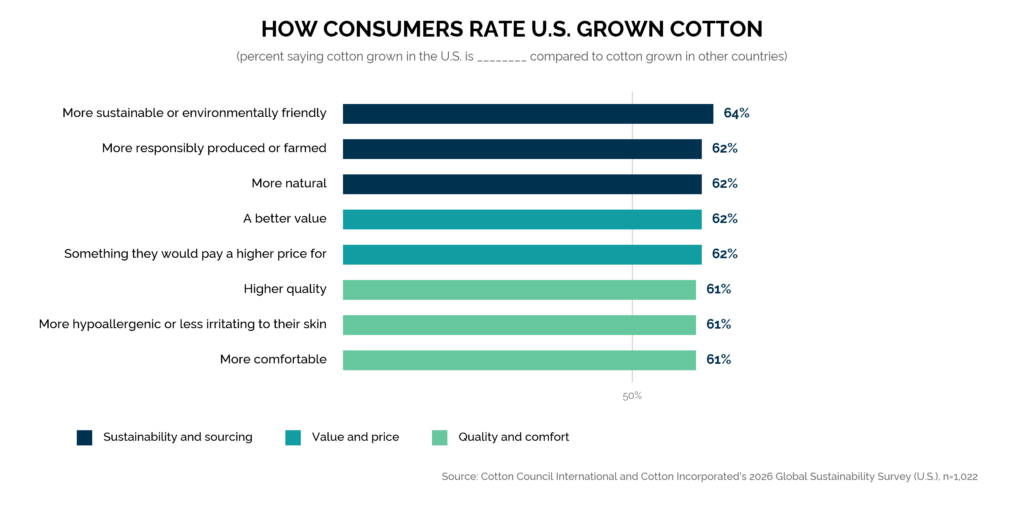
Brands and retailers might also note the majority of consumers (62 percent) say they would pay a higher price for items made from U.S. cotton as opposed to cotton grown in other countries, up from 55 percent in 2023, according to CCI and Cotton Incorporated’s 2026 Global Sustainability Survey of 1,002 U.S. respondents.
These shoppers say cotton grown in the U.S. is more sustainable and environmentally friendly (64 percent), more responsibly produced or farmed (62 percent), as well as a better value and more natural (both 62 percent). Consumers also feel U.S. cotton is higher quality (61 percent), according to the 2026 Global Sustainability Survey.
Reliable Information Regarding Fiber Origin
The EFS® System software can help brands deliver on those consumer demands. For example, the EFS® MILLNetTM Software ensures spinners can consistently hit their quality goals while maximizing inventory and producing yarn using the most sustainable methods possible. The system also provides transparency by allowing spinners to pass along data needed by the rest of the supply chain regarding the origins of the cotton used and associated details to meet regulatory requirements.
“Brands increasingly need reliable information regarding fiber origin, sustainability programs and supply chain practices to support consumer expectations, regulatory requirements and internal ESG (environmental, social and governance) goals,” Martin said. “EFS® MILLNetTM helps organize and communicate cotton-related data throughout the supply chain, making it easier for brands to understand where cotton originated, how it was managed and how it aligns with sourcing requirements.”
Meanwhile, the EFS® USCROPTM software allows users to view High Volume Instrument (HVI) properties of USDA classed cotton either individually or by range. This helps cotton buyers get an idea of fiber properties and amounts of U.S. cotton ginned in a given crop year for their specific end use and in turn make more informed purchasing decisions.
The Cotton CommunicatorTM Software enables cotton merchants/co-ops and mills to exchange information related to the buying and selling of cotton.
Beyond Traceability Tools
Beyond traceability tools, Cotton Incorporated’s Mary Ankeny, vice president of product development, said supply chains are also scaling bio-based products to expand cotton’s naturally sustainable properties.
“From a textile chemistry perspective, supply chains are turning to their chemical suppliers to ask for textile dyes and chemicals that are partially or fully formulated from natural materials to provide a bio-based and, in some cases, biodegradable solution to enhance the sustainable impact of utilizing cotton as a natural and biodegradable fiber in their apparel collections,” Ankeny told the Lifestyle MonitorTM in an interview. “In addition to promoting the safety of their chemical products, chemical manufacturers are now reporting on the bio-based content and the degree to which these products can biodegrade.”
As Martin pointed out, supply chains have become much more data-driven and connected than they were even a few years ago, making new tracing technologies invaluable. “Brands and retailers now expect better transparency, traceability and sustainability information throughout the cotton supply chain.”
And now the tools exist to help do just that.
Brands and retailers now expect better transparency, traceability and sustainability information throughout the cotton supply chain.
Vice President of Fiber Competition, Cotton Incorporated