
It has been said U.S. farmers feed the world. Likewise, it can be argued that U.S. farmers help clothe the world, as well. The U.S. is among the top cotton-producing countries globally, and American growers lead the world in responsible agriculture and land stewardship. As the apparel industry grapples with waste and pollution, makers of everything from sportswear, activewear and denim to T-shirts and athleisure apparel might consider the eco-conscious and sustainable option U.S. cotton presents.
Measurable Progress in U.S. Cotton Production
Cotton Incorporated’s Jesse Daystar, Ph.D., vice president and chief sustainability officer, detailed the measurable progress made by U.S. cotton growers.
“Over the past four decades, U.S. cotton has reduced soil loss by 45 percent, improved irrigation water-use efficiency by 58 percent, reduced greenhouse gas emissions by 25 percent and improved land-use efficiency by 30 percent,” Daystar told the Lifestyle MonitorTM, citing data from Cotton Incorporated’s 2023 National Resource Survey . “That progress is tied to better practices and better tools. More growers are using cover crops, reduced tillage, no-till or strip-till, precision agriculture, irrigation scheduling, flow meters and soil moisture monitoring.”
Of note, Cotton Incorporated commissioned WSP USA Inc., to conduct the most comprehensive, data-driven life cycle assessment (LCA) of U.S. cotton fiber production to date. It found that cotton’s natural fiber composition creates biogenic carbon dioxide storage – a distinction that separates it from petroleum-based synthetic fibers. Further, when temporary biogenic carbon dioxide flows are accounted for, cotton production achieves a net negative cradle-to-gate (field-to-gin) emission of -0.264 kilograms CO2 per kilogram of U.S. cotton fiber. The LCA also found that opportunities exist to enhance cotton circularity and further improve the permanence of the storage, further positioning U.S. cotton as a credible, science-backed natural fiber choice for brands, retailers and consumers.
Sustainability Matters to Consumers
The fashion industry should also keep in mind 3 out of 4 consumers (75 percent) are interested in sustainable clothing, considering it either essential (21 percent) or nice to have (54 percent), according to Cotton Council International and Cotton Incorporated’s 2025 Global Lifestyle Monitor Survey of 13,026 respondents. Fully 83 percent consider cotton and other natural fibers to be safe for the environment, while fewer than half believe that manmade fibers – including rayon (48 percent), polyester (46 percent) and Tencel (41 percent) – are safe for the environment.
“The 2023 Natural Resource Survey also shows continued adoption of conservation practices,” Daystar said. “Cover crop use increased from 20 percent of respondents in 2015 to 48 percent in 2023. No-till and strip-till use also increased from 2008 to 2023, while conventional tillage declined.”
Cotton Leads Global Fiber Preferences
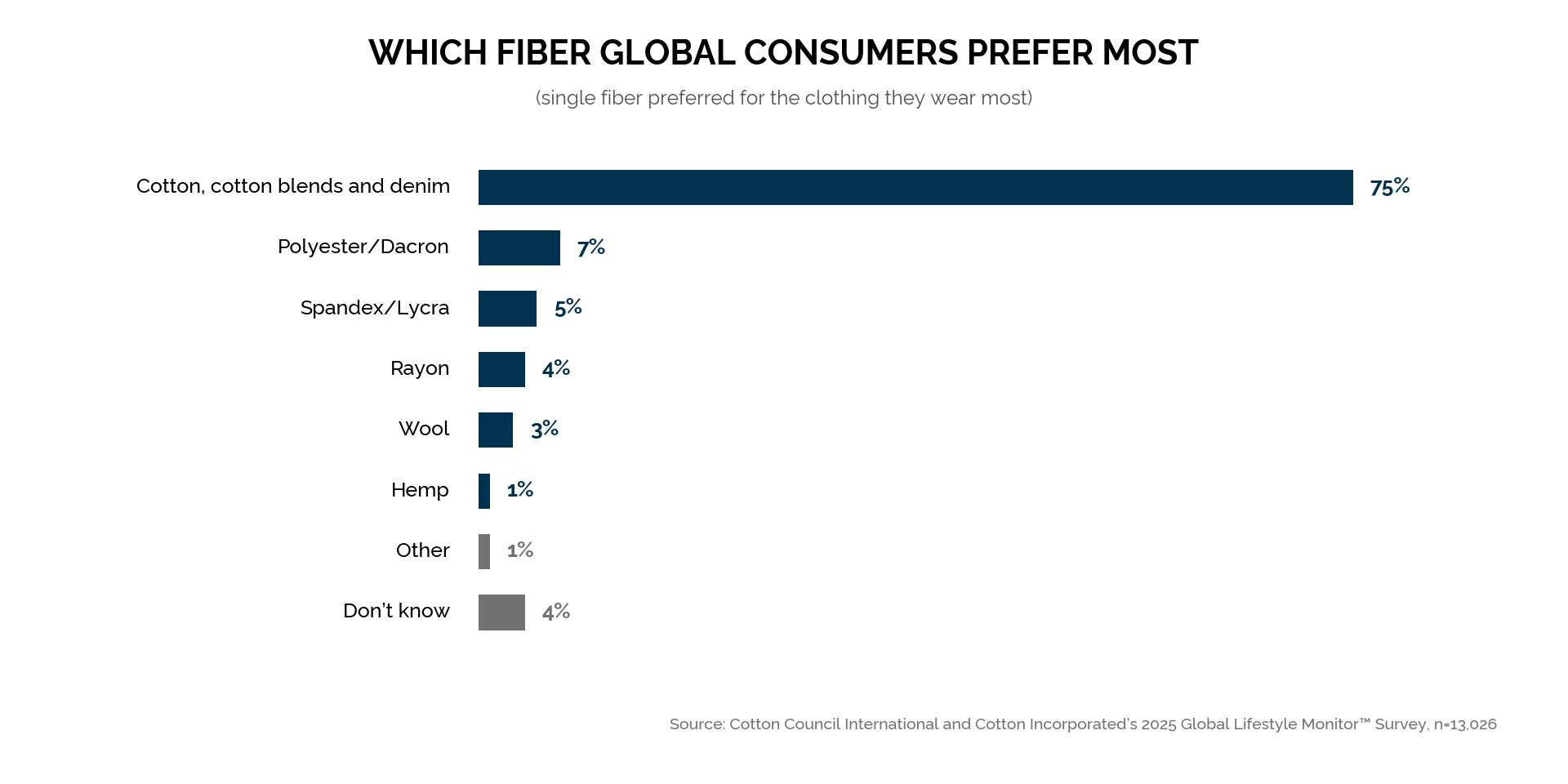
All of this effort to improve on-farm sustainability isn’t lost on consumers. Brands and manufacturers should note fully 75 percent of shoppers prefer apparel made of cotton, cotton blends or denim. These three are overwhelmingly preferred over manmade fibers, including polyester (7 percent), spandex (5 percent) and rayon (4 percent).
Brands often cite the lower cost of polyester for using it so much. At the same time, the fashion industry is guilty of extraordinary textile waste due to overproduction and unsold garments. United States Environmental Protection Agency has found that in America alone, 85 percent of all textiles end up in landfills on a yearly basis .
Now consider that nearly 70 percent of the world’s textile fibers are now synthetic, including polyester, which is petroleum-based. Whether through wearing or washing, all garments release tiny microfibers. But the fibers released from petroleum-based fabrics like polyester are called microplastics. These fabrics can take hundreds of years to degrade, releasing microplastics into the air and soil, exacerbating the global issue of microplastic pollution.
Responsible Agriculture From the Farm Forward
“There’s a gap between how the fashion industry talks about responsible, regenerative agriculture and what’s actually been happening on U.S. cotton farms for years,” said Liz Hershfield, executive director of Cotton USA™ and co-director of U.S. Cotton Trust Protocol in an interview with the Lifestyle MonitorTM. Responsible cotton stewardship is something that they’ve built their business around, because without it, there is no business.”
Hershfield said growers were also among the early adopters of precision agriculture tools — including satellite imagery, drone technology, and AI-driven agronomic management that helps them optimize yields while improving environmental impact.
What Cotton Sourcing Means for Brands
Here’s the kicker: Around the world, most consumers (59 percent) say they are willing to pay more for clothes made of natural fibers like cotton, according to the 2025 Global Lifestyle Monitor research. The percentage is even higher in countries like India (85 percent) and Mexico (66 percent). Further, consumers say they would prefer clothing made of cotton because it’s the most comfortable (67 percent), the softest (66 percent), the best quality (59 percent) the most sustainable (49 percent) and lasts the longest (44 percent).
“Apparel brands should care because the sustainability story of a garment starts with the fiber,” Daystar said. “U.S. cotton gives brands a natural, trusted and data-backed fiber with a real story of continuous improvement from the farm forward.”
Hershfield said brands often don’t realize what’s at stake when they choose fossil fuel-based synthetics over natural fibers like cotton.
“There are [more than 15,000] cotton farms across 17 states, and 98 percent of them are family-owned and operated …and [their] futures are shaped, in part, by the sourcing decisions brands make,” Hershfield stated. “Growers have been absorbing difficult market conditions for several years now. Infrastructure built over generations erodes when demand isn’t there to support it. That’s something brands have more influence over than they often realize.
Apparel brands should care because the sustainability story of a garment starts with the fiber
Vice President and Chief Sustainability Officer, Cotton Incorporated